The Story You’re Telling About Your Child’s Behavior

Want the resource that goes with this blog? Grab my Curiosity Flashcards for free to help you move from assumptions about your child’s behavior to questions that help you understand what’s actually going on.
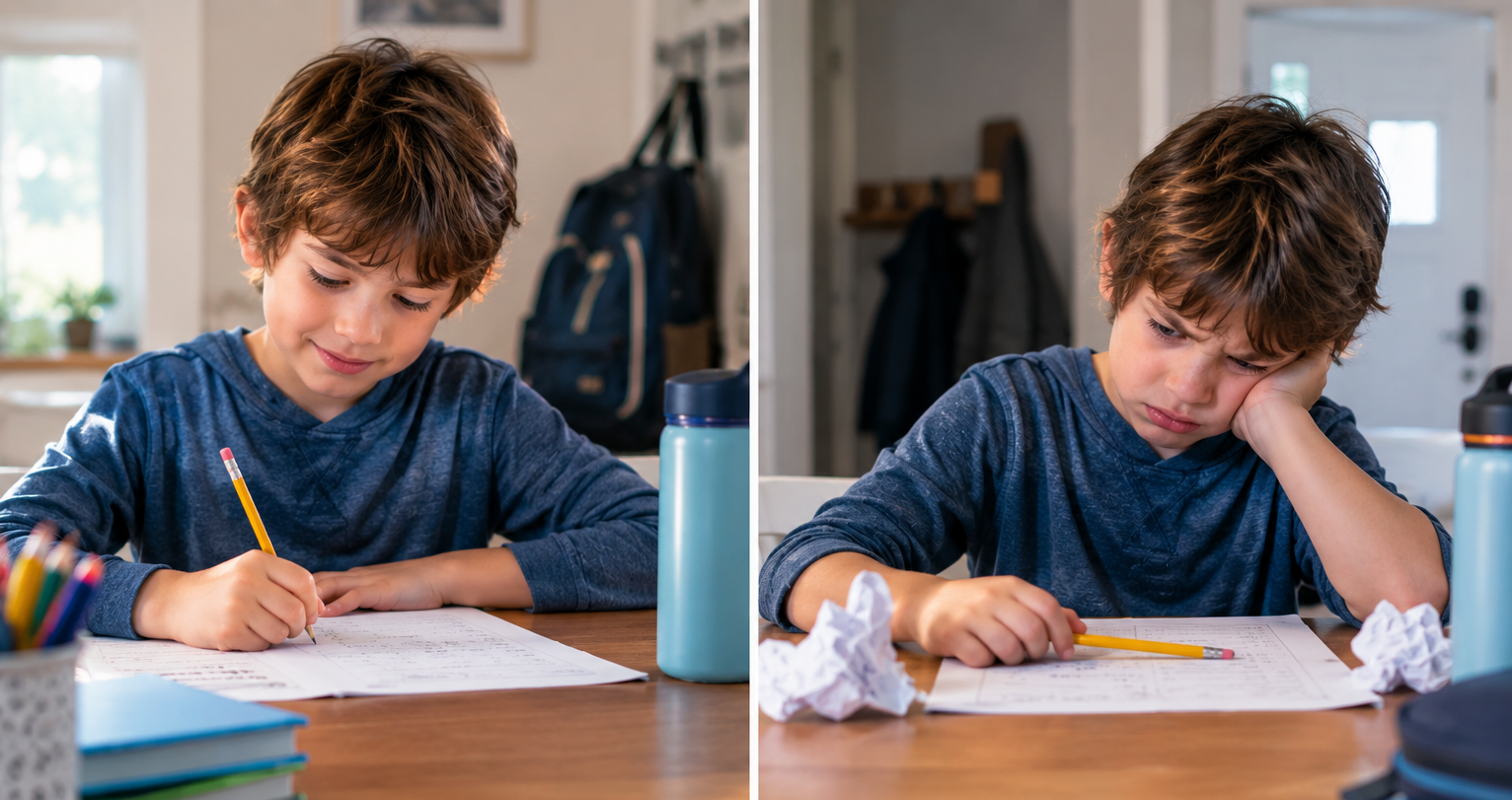
Your child is sitting at the table with their math book open, but they haven’t started.
You’ve already reminded them twice.
You look over again and think, They’re refusing to do their work.
That seems like a straightforward description of what’s happening. You asked them to start math, and they haven’t started. What else would you call it?
But refusing isn’t actually what you observed.
You observed that their math book is open, their pencil is on the table, and five minutes after you asked them to begin, they haven’t written anything.
Maybe they are refusing. They could also be confused about the first problem, overwhelmed by how much work is on the page, distracted by something else, worried they’ll get it wrong, unsure where to begin, or still mentally transitioning from whatever they were doing before.
At this point, you don’t actually know. You assume you know; but that’s it… an assumption. (You’ve heard what happens when you assume right? Yikes! 😅)
And that space between what you know and what you’ve concluded is where neutral observation becomes incredibly useful.
Our brains fill in the blanks quickly
We take in information about our children all day long, and our brains make meaning from it almost immediately.
Your child doesn’t answer when you call their name, and you think, They’re ignoring me.
Your child complains when you ask them to help, and you think, They’re being disrespectful.
Your child leaves their things all over the house, and you think, They’re so careless.
Your child keeps getting out of their seat during school, and you think, They’re trying to get out of doing the work.
Your child melts down when you say it’s time to leave, and you think, They always make everything so difficult.
We usually aren’t sitting there consciously choosing these interpretations. I’m not watching my child move at a snail’s pace through his morning routine thinking, Okay, let me carefully construct a story about what this means. The thought is just there: He’s ignoring me. He doesn’t care that we need to get moving. Why do I have to say everything five times? The observation and the meaning we assign to it happen so close together that they can feel like the same thing.
Neutral observation slows that process down enough to separate the behavior from out interpretation.
As part of the PEACE process which I wrote about previously (check a few blogs down), I teach parents to Acknowledge What Is True. One piece of that is learning to describe what we can actually see and hear without immediately adding our evaluation, interpretation, or criticism.
A helpful way to think about it is: What would a video camera have recorded? Not what would the camera crew assume was happening. But: What could they literally see and hear?
A camera could record that you called your child’s name twice and they continued looking at the tablet.
It couldn’t record that they were ignoring you.
A camera could record that your child said, “I hate math,” pushed the worksheet away, and put their head on the table.
It couldn’t record that they were trying to get out of doing something hard.
A camera could record clothes on the bedroom floor.
It couldn’t record that your child is lazy or doesn’t care about their belongings.
The interpretation could eventually turn out to be accurate. Neutral observation doesn’t require us to decide that it’s wrong. It simply asks us to recognize which pieces we know and which pieces we’ve added.
The story changes what we do next
This matters for more than having technically accurate language.
What we believe is happening affects the way we respond to our child.
If I believe my child is refusing to do math, I’m already preparing to respond to refusal. I may become firmer, repeat the expectation, warn about what will happen if the work isn’t completed, or start explaining why avoiding difficult things isn’t an option.
If I recognize that what I actually know is my child hasn’t started math, there’s still a problem to address. School hasn’t disappeared from the schedule. I’m still the parent responsible for helping us move forward.
I just haven’t decided why they haven’t started.
That leaves room for information.
Maybe they look at the first problem and say, “I don’t understand what this is asking.”
Maybe they tell you, “There are too many problems.”
Maybe they say, “I was finishing the thing I was thinking about before you told me to start.”
Maybe they really do say, “I know how to do it. I just don’t want to.”
Now you know more than you knew five minutes ago.
All behavior communicates something about what is happening for the child, whether we’re looking at nervous-system state, an unmet need, a missing or developing skill, or some combination of those things.
Neutral observation keeps us from deciding what the behavior is communicating before we’ve gathered enough information to understand it.
Neutral doesn’t mean you have to feel neutral
This is an important distinction because “neutral observation” can sound like we’re asking parents to become emotionally detached from things that are genuinely frustrating.
You don’t have to be neutral about finding the shoes outside for the fourth time this week.
You don’t have to enjoy repeating yourself every morning.
You can be angry that your child hit their sibling.
You can feel overwhelmed when school has taken three hours and you’ve completed twenty minutes of actual work.
Your feelings are information too.
And listen, I’ve gotten plenty of practice with this one lately. A few weeks ago, I was already in a funk, and my son moving at the speed of a drowsy snail each morning was melting me from the inside out. I caught myself thinking, If he would just listen the first time, I wouldn’t have to get increasingly irritated. I was telling myself I felt ignored and that my time and schedule didn’t matter to other people.
There were real feelings and needs underneath those thoughts, but there were also interpretations of what my son’s behavior meant.
When I’m already depleted and I interpret his slow movement through the morning as evidence that my time doesn’t matter, I’m no longer responding only to what he’s doing. I’m responding to what I’ve decided his behavior says about me and my needs.
Neutral observation gives me a way to separate those pieces.
I can acknowledge my own frustration honestly while also asking, What is actually happening with him right now? What did I see? What did I hear? What am I adding to that?
I don’t have to replace my negative interpretation with a positive one. If I go from He doesn’t care about my time to He’s just overwhelmed, I’ve still made an assumption.
The point is to come back to what I know.
Curiosity works better when we haven’t already answered the question
This is where neutral observation and curiosity fit so naturally together.
Imagine I ask my child:
“Why are you refusing to do your math?”
I technically asked a question, but I already supplied part of the answer. I’ve decided that what’s happening is refusal.
Or I ask:
“Why are you ignoring me?”
Now my child has to respond to my interpretation before they can even tell me what was happening for them.
Compare that with:
“You’ve looked at the first problem for a few minutes, but you haven’t started writing. What’s going on?”
Or:
“I called your name twice while you were looking at the tablet. What was happening?”
Now I’m asking about something I actually observed and leaving room for information I don’t have yet.
This is exactly why curiosity is such a big part of the work I do with parents. It’s also why I created my Curiosity Flashcards. When you’ve dealt with the same behavior over and over, it becomes incredibly difficult to come up with a curious question on the spot. You already have history with the behavior. You already have theories.
You’re probably frustrated.
The flashcards give you language to help get underneath behavior when you want to understand more before deciding what it means.
Start with what is true
Neutral observation also changes the way we talk about problems with our children.
“You’re so messy and disorganized” gives your child a judgment about who they are.
“There are clothes on the floor, and your backpack and shoes are still in the hallway” gives you something concrete to address.
“You’re being disrespectful” requires your child to accept your evaluation of their behavior.
“You said, ‘Leave me alone,’ and slammed the door” gives both of you the actual interaction to talk about.
“You never listen to me” invites an argument about all the times your child has listened.
“I asked you twice to put your shoes on, and they’re still beside you” keeps the conversation with what is happening right now.
This doesn’t mean we never talk about patterns, impact, expectations, or responsibility. We need to do all of those things as parents. Neutral observation gives us a cleaner place to begin those conversations.
When we start with an evaluation, our child often has to work their way through our judgment before we can even get to the problem. When we start with what happened, we have something concrete in front of us that we can understand, address, and problem-solve around.
And sometimes what we learn through that process confirms part of what we suspected. Other times, our child gives us information that changes our understanding completely.
We don’t have to know which one it will be before we ask.
The next time a behavior immediately becomes disrespectful, lazy, defiant, manipulative, ignoring me, or refusing in your mind, try stripping the situation back to what a camera could have recorded.
What did your child actually say?
What did they actually do?
What happened immediately before and after?
Then notice what your brain added to those facts.
You still get to address the behavior. You still get to hold the boundary. You still get to lead.
Now you’re starting with what you know instead of responding to a conclusion you haven’t had the chance to examine yet.
So… What now?
Recognizing “They’re refusing” as an interpretation is useful, but in the middle of a hard moment, you still need a way to find out what’s actually happening.
And when you’re already frustrated, curious questions are a whole lot harder to come up with. You’re trying to get out the door, finish the lesson, stop the sibling fight, or figure out why something that should have taken ten minutes has somehow taken forty-five. Your brain already has a theory about the behavior, and now you’re supposed to casually come up with a thoughtful question that doesn’t lead your child straight toward that theory?? Yeah, right.
That’s why I created my Curiosity Flashcards.
They give you questions you can pull from when you want to understand what’s underneath your child’s behavior without starting from lazy, disrespectful, refusing, ignoring me, or whatever interpretation showed up first.
You don’t have to come up with the perfect question while you’re frustrated. You can have the language ready for you.